
Create inspiring possibilities with (the other) AI
Yep, not that "AI", there's another one!

The tech world remains obsessed with the potential power of "AI" systems — you know, Artificial Intelligence. This technology could fundamentally change our relationship with computing systems; heck, I've even personally created a ChatGPT to help people know "What Would a Buddha Do?"
Meanwhile, though, there's a different system called "AI" by its devoted practitioners that's worthy of our attention. Although this AI isn't garnering many headlines right now, it targets a vital area needing improvement: the nature of business practices within organizations. The AI I'm talking about here is Appreciative Inquiry.*
This methodology is a goldmine for Possibilitarians and anyone who's on a mission to improve business practices while fostering positive emotional states (it me!!).
Appreciative Inquiry (AI in the remainder of this post) is based on research and theories about the opposite of the kind of "deficit thinking" which seeks to fix things that aren't working. Instead of focusing on deficits, AI involves establishing an affirmative intent and conducting a strengths-based and deeply participatory investigation into those things that ARE working so that they can be amplified and new possibilities can be created.
The concepts and approaches of AI first emerged in the 80's based on research by David Cooperrider and Suresh Srivastva into social system design, which Cooperrider expanded into a full-fledged model by the late '90s when AI began to more directly target organizational development and transformation. Other great minds have carried forward research and applications of AI to business contexts. It's been leveraged successfully by organizations as varied as Apple, Johnson and Johnson, Coca-Cola, The UN, The City of Cleveland, and the U.S. Navy. (Cooperrider Center)
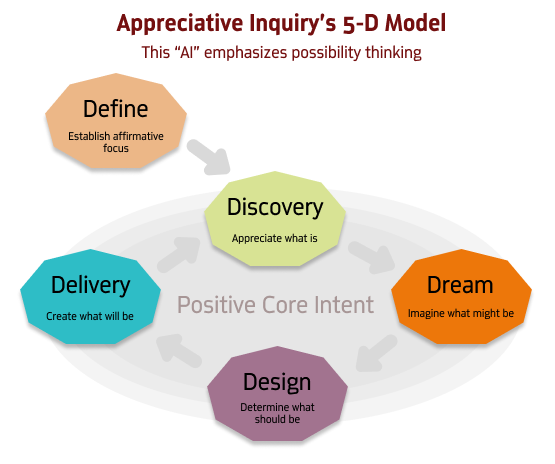
The AI Method
The AI method unfolds around an applied "5-D Model" comprising five phases:
Define
Discovery
Dream
Design
Delivery
Every phase of AI explicitly takes a positive orientation towards the affirmative focus of the inquiry, in both psychological (mind) and philosophical (theory) terms. Rather than emphasizing and unpacking problems, AI promotes "possibility thinking" to explore what might be and what should be to innovate towards what will be. AI fuels innovation towards a desired future by dreaming and making that future into something the team can explicitly design and deliver.
On the surface, these “D” phases look curiously similar to that of many vaunted design processes (such as the double-diamond of design thinking with its four phases of "Discover"; "Define"; "Develop"; "Deliver"). However, in business contexts, the design process tends to position itself as a "problem-solving" endeavor that most often begins with the identification of a problem rather than some good or great goal that the organization wants to create or amplify. (Feel free to debate me since this is eminently debatable! The movement within Product Management circles to pursue “outcomes” reflects a healthy orientation towards positive thinking, for example. More to unpack here for sure….)
AI also has a core set of five principles which are juicy and thought-provoking:
The Constructionist principle: our subjective views, including the language we use, determine our thoughts, actions, and behaviors
The Simultaneity principle: no question is neutral, and the inquiry itself affects the system it’s investigating (very Heisenbergian!)
The Poetic principle: we can choose to make a difference and create optimistic visions to awaken the best in ourselves
The Anticipatory principle: what we do right now is shaped by our vision for the future, and this itself impacts our present
The Positive principle: asking positive questions emphasizes the positive core of an organization, and creating lasting change relies on the fundamental power of positive emotions to encourage creativity and innovation
I won’t regurgitate a case study here, but AI literature is littered with studies containing findings such as:
focusing on strengths provides energy for innovation
utilizing strengths enhances people’s proficiency
collective and participatory inquiry encourages the creation of a learning culture
cultures that are innovative, proficient, and good at learning foster organizational adaptability and encourage them to make more sustainable changes
Isn’t that just delicious?
An Example of Applied Appreciation
Caveat emptor: I personally haven't been certified in the AI methodology, nor have I led a 5-D Appreciative Inquiry effort. However, I have often introduced and/or led a common ceremony in agile product development teams that has a similar resonance: the Retrospective.
The Retro, as it's fondly known, is a team activity held after milestones that involves three steps. First, everybody individually identifies things that went well, and the team discusses the items presented. Next, everybody individually identifies things that went not-so-well, then discusses them as a team. Finally, the group collectively identifies and prioritizes actions to take going forward, which usually includes both amplifying positive things and improving anything negative.
This ceremony has worked wonders for my teams’ morale and effectiveness in various organizations where I've promoted and practiced it. Crucially, in the Retro we first celebrate the good things, highlighting each other's accomplishments and what the team achieved as a whole. Having studied AI and positive psychology, now I understand how beginning with this step causes us to elevate our mindsets and heartsets towards those appreciative modes that help build trust and connection among people. It’s important to note that this ceremony has a positive impact when it's practiced consistently over time and when the team's leaders not only participate but actively ensure that identified actions are pursued (which of course I’d do). Enacting those improvements helps earn people’s respect, and establishes a virtuous cycle that empowers team members to be more appreciative of each other and also more vulnerable and open to sharing what didn't go well because they feel psychologically safe.
Psychological safety cannot be underestimated in its ability to promote team cohesion, improve people's morale, and otherwise support businesses delivering concrete results. A business culture lacking psychological safety leads directly to employee disengagement (if not full-on attrition) that’s associated with trillions of dollars of lost productivity — almost 9% of global GDP! (Gallup)
Curious — where might you have seen the power of appreciation actively benefit a team? Have you also seen happy results in your organization from conducting Retros that are safe spaces and whose leaders follow through? Share your stories if you are so inclined!
* I feel badly for these AI practitioners who’ve seen their fine little acronym usurped in the popular imagination….