
Hiring is part art, part science
Be consistent and patient

In my new role as VP of Product at a midsize company, I’ve had the opportunity to hire four practitioners: two Product Managers and two Product Designers. Hiring activities consumed a large amount of my time in my first few months there, and just last week I filled the fourth & final role. There were times my patience for the process ran thin, but hiring well is just too important to give in to momentary discomfort.
Hiring well is an art as much as it’s a science. I benefited from adopting a consistent process, and also staying in touch with my emotional intelligence throughout the process. Some logistical approaches I took towards this hiring effort included:
Proactively sharing the job across my networks
Being honest and forthcoming about the nature of the work with candidates
Having a script I followed for every initial interview to gain more objective, standard inputs about each candidate
Organizing a series of interviews with stakeholders representing different collaborative functions for the role
Keeping the final group interview to work on an interactive “case study” small and friendly — without requiring any homework in advance
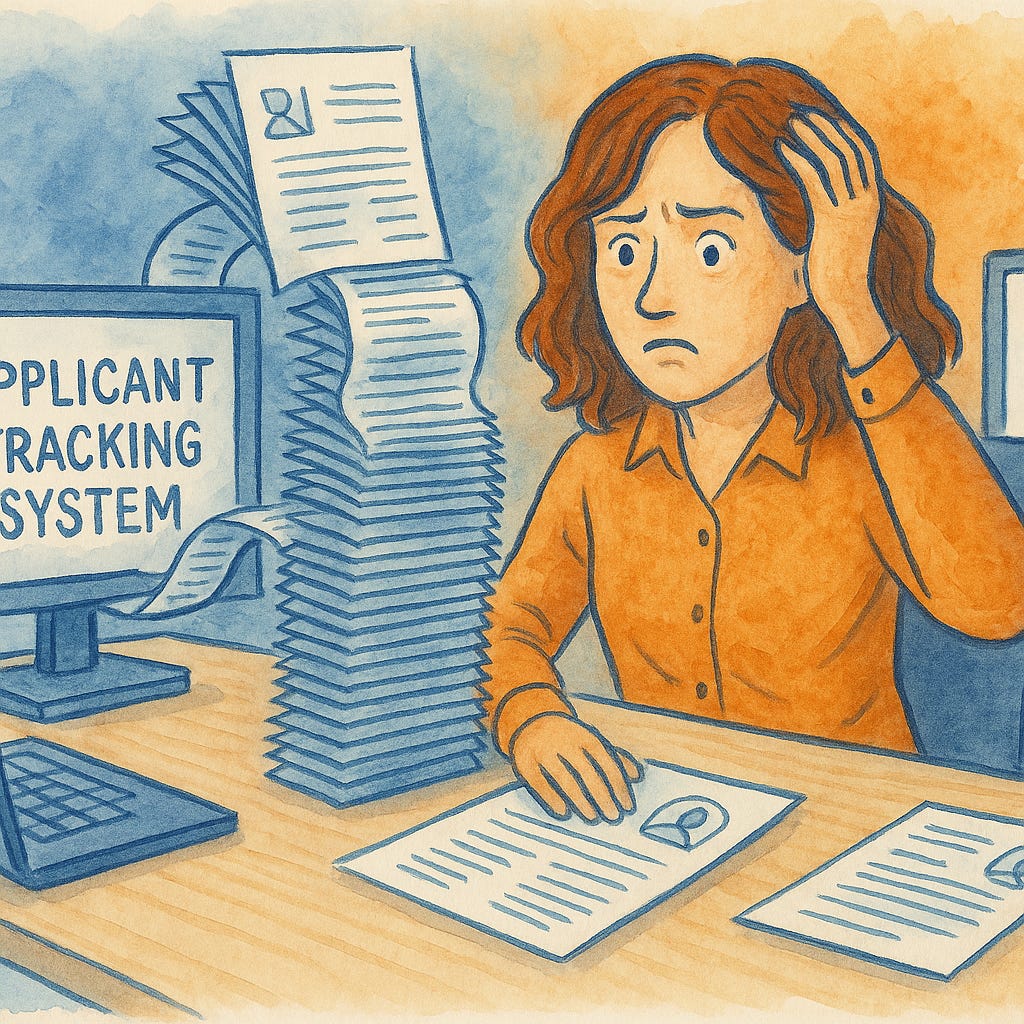
It’s an absolutely crazy thing to receive well over two hundred people’s applications for a given role, the majority of which are decently qualified. It’s an overload for hiring managers and even the professional recruiting team. And I now hate the Workday applicant tracking system with an abiding passion. It’s so incredibly difficult to navigate this system to view resumes in any meaningful way. It doesn’t even have a search function so that I can find an applicant by name amid the giant list! I could go on and on about its usability and functionality failings, but let’s leave it at that.
Skill balance
With these two roles to support each of my two primary product lines, I was able to focus the job requirements of each role more narrowly on their core skillset. In other words, I could hire more of a specialist than a generalist. For both roles, I needed candidates to be able to quickly size up a situation and start modeling the problem and solution space. For product managers, however, this happens more on the order of handling operational structures, determining system needs, and prioritizing work in the larger scheme of things. For product designers, this happens more on the order of understanding users, envisioning solutions, and defining interaction models.
I also needed to build a team for undertaking an ambitious replatforming project with an aggressive deadline, without sacrificing the need for these hires to be valuable for the long-term. So I identified three key qualities I’d judge candidates by across their skill sets, in priority order:
Execution excellence — can they hit the ground running and execute effectively on their responsibilities?
Ability to research & analyze — can they find their way through complex problems?
Strategic orientation — can they pull up from the tactical level and assess matters against a broader strategy?
Organizational fit
It’s a kind of puzzle, creating a team of people where previously there was none. This interplay slowed down the hiring in my situation since I wanted to ensure I was balancing people’s creative and analytical skills in their respective areas. It’s also tricky to evaluate potential team dynamics conceptually, since it’s always a guessing game how other humans will relate to each other in practice. I had to listen to my intuition while being highly observant of how candidates interacted with me, and what their words, behaviors, and actions showed.
Organizationally, candidates usually need to pass muster with a key stakeholder or two. Whether that’s a departmental manager who wants to shape her team or a business stakeholder who will be a close working partner, the hiring process is a good time to bring in these invested people and get a diversity of views on candidates.
In my context, my Product Managers and Product Designers will coordinate with a Lead Engineer, so this person was somebody who I included in the interview cycle. To get the process underway, I provided them with my own interview guide and gave them an overview of my intent and vision for the roles. After each interview, we would have a quick async debrief. His perspectives on how well my candidates would seem to coordinate with engineering were invaluable.
Tips for candidates
In case you’re looking for a role and feeling frustrated by the hiring process, it’s not just you: it’s a jungle out there and in here! I’ll share a couple tips from the perspective of a busy hiring manager:
Feel free to reach out on LinkedIn to add context to your application — but please, don’t hit me up for an interview outside the hiring process.
In Slack communities, ping back with a DM but similarly please don’t ask for a live conversation.
A follow-up inquiry is also totally reasonable. I did learn that Workday will send an automatic rejection notice to any candidates still in the system when a person is hired, so I’m glad that our company isn’t ghosting people. Since the hiring process took four solid months for this final hire, though, candidates could be forgiven for thinking they’d been ghosted.
Make your resume sing. Hiring managers really do read them, and an impactful first sentence will stand out. I’m still smiling over the resume that started out: “Every day I jump out of bed ready to improve healthcare!”
Layout is important. Make sure it’s easy to skim your resume quickly to see a progression of roles.
We also need to understand your dates of tenure in prior roles. Having lots of short roles (1 or 1.5 years duration) is a red flag. Hiring is too important and difficult to feel like we’ll just go through it all again in a year or so because a candidate likes to job-hop.
Top-notch candidates send thank you notes.
While not doing so probably won’t kill your chances, it’s that little “cherry on top” for viable candidates.
Regards
I want to note that due to sharing across my network, people I know personally applied for these roles, or friends of friends were referred to them. It’s tough to go through an interview process with a friend or direct referral and then have the fit not be right or have the person not pass muster for a key stakeholder.
So if you interviewed and didn’t get the role, please don’t take it personally. I hold onto the belief that the universe has our backs, and another opportunity is always out there where the fit is perfect and the situation gels. May any readers who glanced off these roles receive my sincere best wishes for finding the right thing!
This new role presents many learning opportunities. I look forward to growing and evolving as a manager and leader, and continuing to share insights via this newsletter. Thanks for listening!
Lizz at Devise is a publication concerned with professional matters of software product design and development, digital health technology, emotional intelligence, and other such delightful topics. Getting underway in this new role has been rather all-consuming, so I greatly appreciate your sticking with this newsletter despite some quiet stretches!
This is why you are a rockstar manager! Don't be pushed to hire the wrong people just to build your team. And, so kind of you to outline your professional boundaries. Best of luck in the new role, they are lucky to have you.